A recurring feature of China's interaction with the West in the modern period is the influence the 'Middle Kingdom' has had on political theory on distant shores - that influence is reciprocal, but I want to focus on the direction of travel Westwards in this post, because I think it is a less familiar, but no less important, story.
I want to tell that story by focussing on two events that best reflect the curiously distorted influence Chinese political practice - or at least how it has been perceived by certain influential Western thinkers - has had on Western politics itself - the eighteenth-century model of "enlightened despotism", and the more recent bundle of ideas loosely named the "Big Society."
What I find most fascinating of all is how many of the theories underpinning the "Big Society" - drawn from behavioural economics and psychology - represent a secularised version of the "natural law" ideas that were used to justify the rule of enlightened despots in Europe. Advocates of both presented Chinese political theory and practice as imperatives that showed the necessity of Europe adopting reforms.
THE DECLINE AND FALL AND RISE OF ROME

In the era of the Enlightenment - what Jonathan Israel has called "a world-transforming ideology...which aspired to conquer ignorance and superstition, establish toleration, and revolutionise ideas, education, and attitudes by means of philosophy" - philosophers and theologians became fascinated with China.
With the caveat that the Enlightenment was more a set of shared premisses than a unified doctrine, thinkers challenging various objects of conventional wisdom - the Biblical account of creation and history, the conflation of religious piety and moral virtue, the political power of the clergy and aristocracy - looked to China to provide counter-examples which might broaden the horizon of possibilities for the West and rejuvenate civic life.
As the historian Norman Hampson argues in The Enlightenment, many Deists (who believe in an impersonal and passive creator - a Divine Providence - who ordered the universe according to rational laws which men can discover using reason) seeking to challenge the power of established churches initially saw developments in history, rather than in the sciences, as their strongest weapon:
 |
| Voltaire (1694-1778) |
"The Chinese millennia themselves constituted a problem for, to quote Voltaire, "authentic histories trace this nation back, through a sequence of 36 recorded eclipses of the sun, to a date earlier than that which we normally attribute to the Flood." [...] As the cosmologists reduced the status of the earth to that of one planet among many, early anthropologists and their more philosophically-minded readers reduced the classical-Christian civilisation and its history from being the story of the divine will made manifest to an account of one of the more fortunate branches of a numerous family. [...] Educated opinion was aware of the intellectual challenge of non-European societies, a much more direct and fundamental challenge to traditional Christian beliefs than any which seemed likely to come from the scientists."
As well as being used to challenge accounts of what had gone before, China was used in arguments about changing the present. The Enlightenment philosophers got most of their information about life in present-day China from the accounts of Jesuit missionaries (whose social status I touched on in a previous post).
Here is a portrait of Matteo Ricci, the most renowned of the Jesuits, who lived in China from 1583-1610:

And here is the cover of the first Latin translation of the Analects of Confucius, from 1687.

Unfortunately, these were heavily biased descriptions of Chinese society and governance. To counter criticism from Rome (chiefly from Dominicans and Franciscans) that they were endorsing idolatry by participating in traditional Chinese rites of ancestral worship, the Jesuits tried to portray these as purely "civic" rituals, and to do this they presented a picture of a Chinese state that perfectly embodied Neo-Confucian ideals of harmony, wisdom and benevolence.

This distortion of the evidence by the Jesuits was to have far-reaching and unintended consequences. In his book East-West Passage, Michael Edwards writes that, "The Jesuits had, in fact, by stressing the importance of natural law in practical politics, put into the hands of eighteenth-century thinkers ammunition for the defence of enlightened despotism."
To portray Chinese rites as being secular, they inflated the importance of Neo-Confucianism (not, strictly speaking, a religion but a set of beliefs that does not require the existence of an immortal personality) in Chinese life at the expense of alternative belief systems, and thus depicted an entire society acting by its maxims - but, in so doing, they supplied Enlightenment thinkers with a model of a peaceful, happy and prosperous society governed by its most highly-educated members without the countervailing powers of established religion or hereditary aristocracy.
Consequently, Hampson tell us, "An idealised Confucianism came to be equated with the pagan values of ancient Rome, and free-thinkers, disconcerted by the fall of the Roman Empire, could now point to China for proof that their secular values were no less politically effective than Christian ones." Foreshadowing Aristotle, Confucius wrote that: "Peferct is the virtue which is according to the constant mean... To go beyond it is as wrong as to fall short." In The Search For Modern China, Jonathan D. Spence writes: "Unable to find a "philosopher-king" in Europe to exemplify his views of religion and government, Voltaire believed Emperor Qianlong would fill the gap, and he wrote poems in the distant emperor's honour."
OF MONARCHS AND MONADS
 In the first place, both belief systems were conceived of as peaceful solutions to the threat of religious warfare - in Europe, memories of the Wars of Religion were all too sharp, whilst in China orthodox Confucianism was adapted to assimilate encroaching Buddhism and Taoism, and in 1692 the Emperor Kangxi issued an Edict of Toleration towards other faiths.
Also, they each premised ethical systems on man's free will, the basis for which is man's ability to comprehend, and live in conformirty with, the laws governing the universe. As Donald F. Lach has written, the central thesis of Neo-Confucianism is that "Heaven is Law" (T'ien is Li). Li is universal and is coexistent with, and inseparable from, matter (Ch'i), although "Ch'i is subordinate to Li. [...] Li is the eternal law of righteousness which affirms the spirituality and ethical perfection of T'ien."

"The condition of our affairs, slipping as we are into ever greater corruption, seems to me such that we need missionaries from the Chinese who might teach us the use and practice of natural religion, just as we have sent them teachers of revealed theology."
 The notion that all things in the universe are governed by fixed and immutable forces that, properly grasped, show us the right way to live is found in Neo-Confucianism and in Leibniz's theory of "pre-established harmony", which, according to Davis, describes "an orderly universe created and constantly being regenerated and changed by the dynamic development and action of monads according to their God-ordained natural propensities." Or, as Edwards describes it, "a view of the universe in which the greatest possible variety was held together by the greatest possible unity"; from both perspectives, "the universal and the particular are complementary and interdependent aspects of reality."
Here is an audio version of the chapter on Leibniz from Bertrand Russell's History of Western Philosophy.
The video below explains Leibniz's conception of "pre-established harmony" and monadology better than I can hope to here. The key point is that it avoids the Cartesian difficulty of explaining how mental events can be said to "cause" physical events (the "mind-body problem") by positing a pre-ordained, harmonious coincidence, rather than a physical causal link, between the two.
What Leibniz then did was, essentially, to project a belief in the Christian God back onto ancient Chinese history. Lach writes that: "According to Leibniz, the Chinese "worshipped the great God in the virtues of particular things, under the name of spirits of these things, in order to appeal to the imagination of the people.""
Leibniz was a universalist who believed that religious truth was potentially accessible to all, but that it dependend on the use of rational faculties to aggregate and reconcile the infinite fragments of life scattered across the globe; if he could show that the Chinese, when they had been worshipping nature and their ancestors, had all along been worshipping God's laws (and, indirectly, God) without realising it, he could then safely celebrate the achievements of Chinese civilisation without being accused of championing "superstitious atheism."
Walter W. Davis has described how the Jesuits, "by their devious efforts, inadvertently played themselves into the hands of libertines and rationalists who saw in Confucian philosophy the basis for natural religion." Neo-Confucianism was, in several key respects, a convenient cipher for Deists such as Voltaire and Leibniz, who used "natural religion" to advocate a form of government known to us as "enlightened despotism."
 In the first place, both belief systems were conceived of as peaceful solutions to the threat of religious warfare - in Europe, memories of the Wars of Religion were all too sharp, whilst in China orthodox Confucianism was adapted to assimilate encroaching Buddhism and Taoism, and in 1692 the Emperor Kangxi issued an Edict of Toleration towards other faiths.
At the same time as defenders of natural religion in the West were arguing against the doctrine of "original sin" and for man's "natural" inclination towards the good, they received word that all Chinese similarly believed "man is equipped through reason to understand the immutable and harmonious moral order of the universe...he has a natural propensity for doing what is right and good." And they had a shared view of an impersonal cosmology - Davis writes of a "remarkable coincidence between deism and the Neo-Confucian conception of an impersonal Tao or Great Ultimate."
 |
| Leibniz (1646-1716) |
This is a strikingly similar account to the philosopher Gottfried Wilhelm Leibniz's metaphysics, as Leibniz himself recognised at the time. In 1697 he wrote Novissima Sinica (Latest News From China), based largely on his dialogue with Jesuits.

"The condition of our affairs, slipping as we are into ever greater corruption, seems to me such that we need missionaries from the Chinese who might teach us the use and practice of natural religion, just as we have sent them teachers of revealed theology."
 The notion that all things in the universe are governed by fixed and immutable forces that, properly grasped, show us the right way to live is found in Neo-Confucianism and in Leibniz's theory of "pre-established harmony", which, according to Davis, describes "an orderly universe created and constantly being regenerated and changed by the dynamic development and action of monads according to their God-ordained natural propensities." Or, as Edwards describes it, "a view of the universe in which the greatest possible variety was held together by the greatest possible unity"; from both perspectives, "the universal and the particular are complementary and interdependent aspects of reality."
 Here is an audio version of the chapter on Leibniz from Bertrand Russell's History of Western Philosophy.
The video below explains Leibniz's conception of "pre-established harmony" and monadology better than I can hope to here. The key point is that it avoids the Cartesian difficulty of explaining how mental events can be said to "cause" physical events (the "mind-body problem") by positing a pre-ordained, harmonious coincidence, rather than a physical causal link, between the two.
What Leibniz then did was, essentially, to project a belief in the Christian God back onto ancient Chinese history. Lach writes that: "According to Leibniz, the Chinese "worshipped the great God in the virtues of particular things, under the name of spirits of these things, in order to appeal to the imagination of the people.""
 |
| Neo-Confucian astronomical chart, 13th-Century |
Leibniz sent a copy of Novissima Sinica to August Hermann Francke, a German Lutheran pastor and professor of Oriental languages at the University of Halle, and the two entered into a correspondence that lasted until Leibniz's death in 1716. During this period, Halle emerged as a centre of language studies, which was the reason it held such interest for Leibniz - he was enthralled by the possibility that contemporary written Chinese contained what remained of a mythical Adamic "universal language", as described in the Old Testament.
Michael Edwards tells us that scholars who had grown up in the shadow of the Thirty Years' War "sought for the universal language they were convinced had existed before Babel. Some believed it might be Chinese; by elaborate and totally unfounded argument they came to the conclusion that China had been peopled by the children of Noah before the confusion of tongues. It was even suggested that Confucius was a Christian prophet." Francke's unrealised ambition was to establish a Universal Seminary at Halle that would unite German Pietists and the Eastern Orthodox Churches in preparation for using Russia as a launching-pad for sending Protestant missionaries to China.
 According to Lach, Leibniz thought that if that artificially-contrived language could be re-discovered, it could serve the purpose of overcoming religious strife in the world and reveal that all true ethical systems were derived had the same divine origins: "a means of communication through which philosophers from all parts of the world could transmit abstract ideas, precisely and accurately, despite cultural and linguistic differences."
He became obsessed with the enigmatic trigrams and hexagrams in the ancient text, the I Ching (Book of Changes). Current scholarship suggests that these mysterious forms were simplified depictions of cracks that formed in tortoiseshells when they were heated in divination rituals.

 Decades earlier, he had invented a system of binary numbers in which two rather than ten was the base scale of notation - in the patterns of the I Ching he thought he could see a codification of the same system. As Lach puts it, "he believed that the binary arithmetic was not an invention but a "rediscovery" of Fei Zhi's [the Han-era transmitter of the original text] principles."
The connection between universal religion and universal language made the University of Halle a centre of the German Enlightenment, and a cause celebre of the archetypal self-styled "enlightened despot" - King Frederick the Great of Prussia (Frederick II), who reigned 1740-86.

The University of Halle had been founded by his paternal grandfather, Frederick I, but his predecessor had considered closing it down as it became engulfed in controversial religious dispute - it was kept going, and allowed to operate with expanded royal priveleges, by Frederick the Great, as part of his wider policy of religious toleration and education. "Men", he wrote, "ought to be made to feel ashamed of fanaticism."
Here is a BBC documentary that assesses Frederick's legacy as an "enlightened despot" in more detail.
 The arguments in Halle centred on whether Rome had been right to condemn the Jesuits for their conduct in China - but it took place between different Protestant tendencies. Halle was a centre of the Pietist movement, which Edwards has described as a "controversial current within German Lutheranism, a reaction to the religious warfare which devastated the German states, and also to the rigid formalism of Orthodox Lutheranism."
According to The Oxford Dictionary of the Christian Church it was a revival, chiefly among younger students, of the ideal of faith through good works as opposed to a fixation on ideological purity, and inquisitions that inevitably followed: "it developed into a hard-and-fast system of penance, grace and re-birth... [It] was characterised by various philanthropic activities (centred in Halle) and by its contribution to the missionary movement."
 To their critics, the Pietists came perilously close to suggesting that morality was independent of God's will. But, under the towering influence of Leibniz, the Pietists maintained that this conclusion needn't follow from their doctrine of "pre-established harmony": all it implied was that a society full of people who knew what was right and good was insufficient for a good and right society - they had to actually do something to make the world a better place. Their proselytising activism and charity thus had a metaphysical basis: each dimension in the universe evolves by its own laws, so that one may conform to God's will in one dimension without necessarily doing so in all others (though, due to pre-ordained harmony, it was possible to act rightly in all respects).
 What mattered was doing the right thing, according to the circumstances of each time and place - this was "the spirit of Halle." For Enlightenment philosophers such as Smith, Hutcheson and Malebranche, the human capacity for empathy - "irresistible compassion" - was a crucial God-given impulse that allowed us to act morally without always rationalising it in advance. In the name of the "General Welfare", and of promoting "a more enlarged spirit of charity...among Protestants of both denominations", Francke created a network of charitable schools for orphans - the Frankesche Stiftungen. They were built from a belief that there was room for the "improvement of the mind" alongside "the eternal salvation of souls." Benjamin Franklin wrote that the example of Halle inspired him to create catechism charity-schools in America for educating negro slaves.
Here is one of the charity-schools in Halle.

One of the leading philosophers of the German Enlightenment thought the Pietists rather naive, and they in turn saw him as a treacherous atheist - so much so that they hounded him out of Halle altogether. His name was Christian Wolff.

In 1721 Wolff wrote his Oratio de Sinarum philosophia practica (Discourse on the Practical Philosophy of the Chinese).

Mark Larrimore has argued that Wolff wrote the book to challenge "the understanding of ethics as obedience to the utterly unconstrained commands of an omnipotent deity" - and in so doing, he appeared to many of his peers to be going one step beyond the Pietists. Where they had argued that motivation was not all that mattered in ethics, he appeared to be (though was not in fact) arguing that it did not really matter at all.
The central conclusion Wolff drew from China was that non-believers "were not only capable of recognising the good but were also capable of leading lives of virtue in pursuit of it", and it was that led the Pietists to surmise that "It not atheist in intent...Wolff's system was surely atheist-making in effect." In point of fact, Wolff held that the ancient Chinese were neither believers nor atheists: "An atheist is someone who denies that there is a God. But one cannot deny God if one does not know distinctly what God is."
Instead, "the Chinese realised that virtue consisted in being moved by the intrinsic value of the good, not just in obeying the command of a superior" and they practised "an inductive consequentialist ethics that employed historical examples in place of rules and that found its motive in the just pride of the virtuous."
Wolff argued that humans are capable of three degrees of virtue, which are categorised by their motivation, and which must be progressed through in the following order: empiricism and lessons of experience ("there are natural powers sufficient for the practice of virtue"); natural religion ("consideration of divine Providence"); and divine revelation. He believed that the Chinese had not advanced beyond the first stage but, to their credit, had achieved the most virtue possible within those limits.
More pertinently, he saw his own Orthodox critics as trying to pass to the third stage before completing the second, and he sought to use the example of China to educate them on the importance of toleration and learning: "philosophy was what Christians needed, too, and to appreciate the relevance of philosophy, the example of the Chinese remained indispensable."
Returning to Halle, we can see this city as a critical juncture in the flow of ideas among the most famous of the European monarchs who styled themselves as "enlightened despots." During his final two decades, Leibniz collaborated extensively with the reforming government of Peter the Great of Russia, and both he and his colleagues from Halle helped found the Russian Academy of Sciences - thereby indirectly influencing the continuation of modernising reforms under Catherine the Great.
Meanwhile, Wolff's paean to Chinese "benevolent absolutism" reached Frederick II via one of his former students and, according to Davis, it was a powerful influence on the King's ideological development. Another influence was Voltaire with whom he enjoyed a lasting if turbulent friendship. Voltaire, who wrote a play to propagate the model of China's meritocratic state bureaucracy ('Confucian Morals in Five Acts'), told Frederick, a man who described himself as "a king by nature and philosophe by inclination": "Graft a sovereign onto a philosopher...and you will have a perfect sovereign." Although Frederick wrote to Voltaire, "I leave the Chinese to you...the European nations keep my mind sufficiently occupied", the influence of "far Cathay" was subtly pervasive.
In 1740 Frederick distilled his political vision in the form of an anonymously published rejoinder to Machiavelli's The Prince, called Anti-Machiavel.

Against Machiavelli's proposition that there exists an irresolvable tension between private and public morality (or between that of rulers and that of subjects), Frederick contended that the wise ruler could amalgamate both the most moral, and the most efficacious, ruler - according to the doctrine of natural law, a ruler could know better than his subjects what was good for them and coerce them towards that end, since they would be bound by innate reason to retrospectively acknowledge it as legitimate.
An enlightened despot was, in theory, only a midwife to the rational desires of his or her subjects - the "first servant of the state." "A society could not exist without laws", he wrote, "but it could certainly exist without religion, provided that there is a power which, by punitive sanctions, can compel the masses to obey these laws. This is confirmed by...the government of China, where Deism is the religion of all the leading men in the state."
 Accordingly, Frederick's reign - and that of the other enlightened monarchs - was an energetic one. He streamlined the civil service to make it more responsive to his instructions, simplified the legal codes to provide transparent and predictable justice, abolished torture, and provided limited guarantees of freedom of press and of belief. Here is a description taken from The Columbia History of the World:
 Jean-Jacques Rousseau, a declared skeptic of enlightened despotism, wrote:
In a sense, critics like Rousseau were doing the same thing as the Sinophiles but in reverse - using China as a counter-example to currents of Enlightenment thought to which they were opposed. Rousseau, for instance, obviously found highly convenient the negative reports of a country supposedly ruled by its most highly educated members, since his main argument in the First Discourse was that the sciences corrupted morals.
 Larrimore tells us that "Sinophilia faded with the rise of romanticism, historicism, and imperialism" - in other words, currents of thought that are alternately regarded as offshoots or reactions against early Enlightenment philosophy. Crucially, it faded with the declining vogue for enlightened despotism; as Edwards has written, "The Sinophiles never really considered the people as worthy of their proselytising endeavour...They believed in the Confucian principle that a virtuous administration, operating within the harmony of natural law, was the only way to stability. They were reformers, not revolutionaries." But the late eighteenth-century was an age of revolution, not reform - when it came to that, the enlightened despots blanched, and back-tracked on their promises of reform.
As far as the suggestion that philosophers should rule went, the monarchs "treated such suggestions as they did the chinoiseries of their palace, as a pleasant gloss on the business of living."
I hope this is not too jarring a transition, but I want to jump forward to the late twentieth-century, and to the rise to prominence of behaviourism in public policy-making - because there is a link to both China and enlightened absolutism.
 In 1971 a psychologist named B. F. Skinner wrote a book called Beyond Freedom and Dignity, which laid out his stark case for "radical behaviourism." Here is how the Oxford Companion to Philosophy defines this school of thought:
Simply put, Skinner believed that humans are wholly products of their environments: "Even revolutionaries are almost wholly the conventional products of the systems they overthrow." Once the causal connection between environmental factors and behaviour was understood, experts would be able to predict and manipulate people's behaviour without ever having to ask them about their thoughts and feelings.
Here is an excerpt from a BBC documentary, Great Thinkers: In Their Own Words, which shows Skinner at work - and how he drew lessons about humans from his experiments with animals.

But Skinner too was an optimist in science - the problem as he saw it was not Enlightenment optimism per se, but its incompleteness, and the need to develop a science of behaviour that would yield "a behavioural technology comparable in power and precision to physical and biological technology".
Skinner's ideal society was much closer to a model of technocracy than of democracy as it is usually understood. In the name of the General Welfare people's freedom had to be restricted, because they could not be trusted to make rational decisions - but it was no good doing this through a coercive authoritarian state apparatus, since people did not like feeling that they were being forced in this or that direction, so the means would just have defeated the end. Instead, a third party ought to modify the social environment so that people are left free to choose what they want to do - but the choice is framed in such a way that they are very likely to choose what the third party knows is best for society overall.
In the 1970s Skinner said that China in the early stages of the Cultural Revolution represented the closest real-life approximation to his model society. I am not sure how much he knew about what was really happening at the time, but it is not hard to imagine how he arrived at that conclusion - a state proclaiming itself to be the servant of the people, putting power back into their hands, with the ulterior motive of actually strengthening the power of the state vis-a-vis its citizens by making the culture of state agents more responsive to their preferences.
He was not unaware of the dangers inherent in his peculiar fusion of libertarian elitism, but he believed that, once it was set up, his system would be self-sustaining, and would incentivise those it empowered to use their power for the General Welfare - guided by a "science of values."
 "Who is to construct the controlling environment and to what end? What will the putative controller find good, and will it be good for those he controls? These are really questions about reinforcers... When we say that a value judgement is a matter not of fact but of how someone feels about a fact, we are simply distinguishing between a thing and its reinforcing effect."
If this sounds rather familiar, it should not come as a surprise - the authors of the influential book Nudge collaborated with one of Skinner's colleagues (you can read more about the connections here). Below is a talk given by one of the authors, Richard Thaler, in which he explains that politicians should see their role as being "choice architects", who should "design a society in which people make better choices, as judged by themselves." He calls it "libertarian paternalism" - "libertarian" because people are left to choose and "paternalist" because choices are framed as the state sees fit.
The Prime Minister David Cameron has cited Nudge as an important influence on his thinking, and on his decision to establish a Behavioural Insights Unit in Number 10. The ideas of "radical behaviourism" have also played a part in the evolution of his "Big Society" agenda. Critics of the Big Society, mostly from the left, often argue that it is a fig-leaf for ideological public spending cuts, and that it is hopelessly naive to simply "roll back" the state and expect civil society to automatically flood in and close the gap.
 I think that these criticisms have some validity, but I also think that they miss the point that the Big Society was never premised on this kind of hydraulic interpretation of society. This much is clear if you read Cameron's address to the Young Foundation in 2009, where he set out the assumptions his team were starting from: it is not just about the state of Britain's finances, it is the state of Britain's morals, which has "broken" its social fabric. Since the late 1960s, so the argument runs, the British state has grown inexorably, not just in terms of resources, but also in terms of its functions and reach into previously off-limits areas of private life.
The result is that citizens have become individually far less responsible, so that state retreat, by itself, is unlikely to catalyse 'third-sector' substitutes - what is required is an interventionist state that will reshape society and supposedly make it easier for people to do the right thing by providing examples of moral leadership. To illustrate the point, the speech is worth quoting at length:

Even the branding of the Big Society is not new: in Hainan province during the 1980s-90s a series of political reforms designed by a scholar named Liao Xun were tried under the slogan, "Big Society, Small Government" (xiao zhengfu da shehui). K. E. Brodsgard has written that the project failed to create a "special political zone" (equivalent to the coastal "special economic zones") because of basic contradictions inherent in the "Big Society" ideology itself.
Most importantly, for all the talk of greater "transparency", the philosophy of nudging presumes - requires - a certain knowledge-gap between government and governed: if people know in advance that they are being manipulated towards a certain goal (even if that goal is what they may want from a rational, long-term perspective), they are likely to change their behaviour, because people don't usually like the idea of being manipulated. As David H. Freedman has written in The Atlantic:

But isolating an important part of political decision-making from public scrutiny can actually make it harder to make stable, long-term decisions for the General Welfare because individual decision-makers cannot build a base of mass support and are thus vulnerable to sudden changes in direction driven by issues of personality and administration. It is notable how few of the reforms enacted by the eighteenth-century enlightened absolutists outlived them. Likewise, Brodsgard observes of Hainan:
More recently, the Economist reported that the CPC has revived this agenda in Shenzhen, but "Li Luoli of the China Society of Economic Reform points out that the local ministries and developers have been able to ignore Beijing because there is no specific local body behind political reform."
It is interesting to find how much of the Big Society was motivated by a perceived need by Western governments to streamline their "wasteful" welfare states in order to compete with the Asian "tiger" economies (and, in the post-Mao period, China). Lord Patten, the last governor of Hong Kong and a man on the left of the Conservative Party, saw himself as a spokesman for the "Enlightenment values" of liberal democracy and liberal economics, against a tide of hyperbole about supposedly superior "Asian values" that - as interpreted by the erudite Prime Minister of Singapore, Lee Kuan Yew - emphasise obedience to family and state before individual liberty.
 "The West, it is said, government has become too big as a result of the exaggerated ambitions of politicians and the demands made on them by voters. Citizens in a sense sell their votes to the highest bidders...they are being bribed with their own money. Government finds itself taking decisions, assuming responsibilities, that properly belong to individuals, families, firms. [...] By avoiding the creation of a costly welfare burden for their taxpayers, Asian governments have helped create the growth which ensures that fewer people need welfare support."
Here is an interview with Lee Kuan Yew during a trip to the U.S. in 1967. When an American journalist asks him what he makes of the student protests across the country (at 15:30), he replies to the effect that people will always protest against their government, but it is the government's job to ensure that its policies are ones they will later look back on and approve of retrospectively - a sentiment of which I am sure Voltaire would have approved.
At length, I think we have come full-circle. Just as the "enlightened despots" of eighteenth-century Europe were in a sense Christianised versions of theorised benevolent Oriental despots, it is also plausible to see the "radical behaviourism" of B. F. Skinner as a secularised vision of enlightened despotism (in which Darwinian natural selection has taken on the role of divine Providence, and "nudging" technocrats the role of far-sighted philosopher-kings).
Moreover, just as the Jesuits reduced the complexity of China to the principles of Neo-Confucianism in order to justify their assimilationist approach to missionary work, so too have latter-day Western commentators on "Asian values" often simplified a messy reality in order to argue for the necessity of reforming welfare states in the West - and that the way to do it is to harness the power of the state to transform cultural values.
The constant thread running through this story has been the notion that the universe is characterised in a meaningful way by "pre-established harmony", and that, ironically, this can be used to legitimise alternative forms of government to participatory democracy. But if this is true, why don't the enlightened despots ever seem to agree among themselves?

 |
| August Hermann Francke (1663-1727) |
Michael Edwards tells us that scholars who had grown up in the shadow of the Thirty Years' War "sought for the universal language they were convinced had existed before Babel. Some believed it might be Chinese; by elaborate and totally unfounded argument they came to the conclusion that China had been peopled by the children of Noah before the confusion of tongues. It was even suggested that Confucius was a Christian prophet." Francke's unrealised ambition was to establish a Universal Seminary at Halle that would unite German Pietists and the Eastern Orthodox Churches in preparation for using Russia as a launching-pad for sending Protestant missionaries to China.

He became obsessed with the enigmatic trigrams and hexagrams in the ancient text, the I Ching (Book of Changes). Current scholarship suggests that these mysterious forms were simplified depictions of cracks that formed in tortoiseshells when they were heated in divination rituals.

The book itself is vague about their exact significance - Lach writes: "according to its own appendices the I Ching was constructed in order to picture in simple symbols those universal laws on which humans should model their actions". Leibniz inferred from this that the Chinese had, from the dawn of their civilisation, arranged their society according to meticulous and highly rational, even if largely unspoken, moral laws that reflected the law of nature.
 Decades earlier, he had invented a system of binary numbers in which two rather than ten was the base scale of notation - in the patterns of the I Ching he thought he could see a codification of the same system. As Lach puts it, "he believed that the binary arithmetic was not an invention but a "rediscovery" of Fei Zhi's [the Han-era transmitter of the original text] principles."
 The connection between universal religion and universal language made the University of Halle a centre of the German Enlightenment, and a cause celebre of the archetypal self-styled "enlightened despot" - King Frederick the Great of Prussia (Frederick II), who reigned 1740-86.

The University of Halle had been founded by his paternal grandfather, Frederick I, but his predecessor had considered closing it down as it became engulfed in controversial religious dispute - it was kept going, and allowed to operate with expanded royal priveleges, by Frederick the Great, as part of his wider policy of religious toleration and education. "Men", he wrote, "ought to be made to feel ashamed of fanaticism."
Here is a BBC documentary that assesses Frederick's legacy as an "enlightened despot" in more detail.

According to The Oxford Dictionary of the Christian Church it was a revival, chiefly among younger students, of the ideal of faith through good works as opposed to a fixation on ideological purity, and inquisitions that inevitably followed: "it developed into a hard-and-fast system of penance, grace and re-birth... [It] was characterised by various philanthropic activities (centred in Halle) and by its contribution to the missionary movement."


Here is one of the charity-schools in Halle.

ALL RELIGIONS ARE EQUAL, BUT SOME ARE MORE EQUAL THAN OTHERS
One of the leading philosophers of the German Enlightenment thought the Pietists rather naive, and they in turn saw him as a treacherous atheist - so much so that they hounded him out of Halle altogether. His name was Christian Wolff.
In 1721 Wolff wrote his Oratio de Sinarum philosophia practica (Discourse on the Practical Philosophy of the Chinese).

Mark Larrimore has argued that Wolff wrote the book to challenge "the understanding of ethics as obedience to the utterly unconstrained commands of an omnipotent deity" - and in so doing, he appeared to many of his peers to be going one step beyond the Pietists. Where they had argued that motivation was not all that mattered in ethics, he appeared to be (though was not in fact) arguing that it did not really matter at all.
 |
| Confucius (551-479 BC) |
Instead, "the Chinese realised that virtue consisted in being moved by the intrinsic value of the good, not just in obeying the command of a superior" and they practised "an inductive consequentialist ethics that employed historical examples in place of rules and that found its motive in the just pride of the virtuous."
Wolff argued that humans are capable of three degrees of virtue, which are categorised by their motivation, and which must be progressed through in the following order: empiricism and lessons of experience ("there are natural powers sufficient for the practice of virtue"); natural religion ("consideration of divine Providence"); and divine revelation. He believed that the Chinese had not advanced beyond the first stage but, to their credit, had achieved the most virtue possible within those limits.
More pertinently, he saw his own Orthodox critics as trying to pass to the third stage before completing the second, and he sought to use the example of China to educate them on the importance of toleration and learning: "philosophy was what Christians needed, too, and to appreciate the relevance of philosophy, the example of the Chinese remained indispensable."
 |
| A 'Potemkin village' |
Meanwhile, Wolff's paean to Chinese "benevolent absolutism" reached Frederick II via one of his former students and, according to Davis, it was a powerful influence on the King's ideological development. Another influence was Voltaire with whom he enjoyed a lasting if turbulent friendship. Voltaire, who wrote a play to propagate the model of China's meritocratic state bureaucracy ('Confucian Morals in Five Acts'), told Frederick, a man who described himself as "a king by nature and philosophe by inclination": "Graft a sovereign onto a philosopher...and you will have a perfect sovereign." Although Frederick wrote to Voltaire, "I leave the Chinese to you...the European nations keep my mind sufficiently occupied", the influence of "far Cathay" was subtly pervasive.
In 1740 Frederick distilled his political vision in the form of an anonymously published rejoinder to Machiavelli's The Prince, called Anti-Machiavel.

Against Machiavelli's proposition that there exists an irresolvable tension between private and public morality (or between that of rulers and that of subjects), Frederick contended that the wise ruler could amalgamate both the most moral, and the most efficacious, ruler - according to the doctrine of natural law, a ruler could know better than his subjects what was good for them and coerce them towards that end, since they would be bound by innate reason to retrospectively acknowledge it as legitimate.
 |
| Maria Theresa and family |
In a nod to Confucius, Frederick argued that rulers should set a moral example to those beneath them, or else the moral compass of every man and woman in the nation will be put out of kilt:
"If it is bad to debase the innocence of a private individual, whose influence on the affairs of the world is minimal, it is much worse to pervert some prince who must control his people, administer justice, and set an example for their subjects; and must, by their kindness, magnanimity, and mercy, be someone to be looked up to."
 Accordingly, Frederick's reign - and that of the other enlightened monarchs - was an energetic one. He streamlined the civil service to make it more responsive to his instructions, simplified the legal codes to provide transparent and predictable justice, abolished torture, and provided limited guarantees of freedom of press and of belief. Here is a description taken from The Columbia History of the World:
"Frederick the Great dominated the Prussian nobility, built a large, well-trained army, the best in Europe, and reduced the proud aristocrats to the status of bureaucrats in the service of their war machine. [...] The rapidity of unification and the emasculation of the nobility left Prussian society without any group strong enough to resist the crown... No earlier sovereign anywhere in Europe so thoroughly dominated the machinery of government. He was Europe's closest approximation to an Oriental despot."
Oriental despotism was not without its Enlightenment critics. As alternative eyewitness reports from returning merchants became more widely available in the mid-eighteenth century, attitudes hardened. Montesquieu - who believed liberty was best safeguarded by a government divided into three branches, but also that ideal forms of government for particular societies depended on environmental conditions - argued that the much-admired "public tranquility" of China "was no more than the product of a climate "which naturally disposes the inhabitants to slavish obedience.""

"In Asia there is an immense country where honors for learning lead to the highest offices of the State. If the sciences purified morals...the peoples of China would be wise, free, and invincible. But there is no vice that does not dominate them, no crime with which they are not familiar...of what purpose have been all its wise men?"
In a sense, critics like Rousseau were doing the same thing as the Sinophiles but in reverse - using China as a counter-example to currents of Enlightenment thought to which they were opposed. Rousseau, for instance, obviously found highly convenient the negative reports of a country supposedly ruled by its most highly educated members, since his main argument in the First Discourse was that the sciences corrupted morals.

As far as the suggestion that philosophers should rule went, the monarchs "treated such suggestions as they did the chinoiseries of their palace, as a pleasant gloss on the business of living."
BEYOND FREEDOM AND DIGNITY
I hope this is not too jarring a transition, but I want to jump forward to the late twentieth-century, and to the rise to prominence of behaviourism in public policy-making - because there is a link to both China and enlightened absolutism.

"The thesis that all behaviour, public or private, is governed by the laws of classical conditioning or operant conditioning. Skinner argued that thinking, choosing, and deciding - things about which more draconian forms of behaviourism vowed silence - could be analysed as private behaviours with characteristic causal relations to overt behaviour and as subject to the basic principles of operant conditioning."
Simply put, Skinner believed that humans are wholly products of their environments: "Even revolutionaries are almost wholly the conventional products of the systems they overthrow." Once the causal connection between environmental factors and behaviour was understood, experts would be able to predict and manipulate people's behaviour without ever having to ask them about their thoughts and feelings.
Here is an excerpt from a BBC documentary, Great Thinkers: In Their Own Words, which shows Skinner at work - and how he drew lessons about humans from his experiments with animals.
He believed his theories had important applications to the governance of society and in Beyond Freedom and Dignity he explained that the problems humanity faces today are the consequences of the naive Enlightenment belief in progress through science and technology alongside an emphasis on the fanciful notion of free will:
"In trying to solve the terrifying problems that face us in the world today...we play from strength, and our strength is science and technology. [...] But things grow steadily worse, and it is disheartening to find that technology itself is increasingly at fault. [...] As Darlington has said, "Every new source from which man has increased his powers on the earth has been used to diminish the prospects of his successors. All his progress has been at the expense of damage to his environment which he cannot repair and could not foresee.""
But Skinner too was an optimist in science - the problem as he saw it was not Enlightenment optimism per se, but its incompleteness, and the need to develop a science of behaviour that would yield "a behavioural technology comparable in power and precision to physical and biological technology".
Skinner's ideal society was much closer to a model of technocracy than of democracy as it is usually understood. In the name of the General Welfare people's freedom had to be restricted, because they could not be trusted to make rational decisions - but it was no good doing this through a coercive authoritarian state apparatus, since people did not like feeling that they were being forced in this or that direction, so the means would just have defeated the end. Instead, a third party ought to modify the social environment so that people are left free to choose what they want to do - but the choice is framed in such a way that they are very likely to choose what the third party knows is best for society overall.
 |
| A "struggle session" against "counter-revolutionaries" |
He was not unaware of the dangers inherent in his peculiar fusion of libertarian elitism, but he believed that, once it was set up, his system would be self-sustaining, and would incentivise those it empowered to use their power for the General Welfare - guided by a "science of values."
 "Who is to construct the controlling environment and to what end? What will the putative controller find good, and will it be good for those he controls? These are really questions about reinforcers... When we say that a value judgement is a matter not of fact but of how someone feels about a fact, we are simply distinguishing between a thing and its reinforcing effect."
"If a scientific analysis can tell us how to change behaviour, can it tell us what changes to make? This is a question about the behaviour of those who do in fact propose and make changes. People act to improve the world and to progress towards a better way of life for good reasons, and among the reasons are certain consequences of their behaviour, and among these consequences are the things people value and call good."
If this sounds rather familiar, it should not come as a surprise - the authors of the influential book Nudge collaborated with one of Skinner's colleagues (you can read more about the connections here). Below is a talk given by one of the authors, Richard Thaler, in which he explains that politicians should see their role as being "choice architects", who should "design a society in which people make better choices, as judged by themselves." He calls it "libertarian paternalism" - "libertarian" because people are left to choose and "paternalist" because choices are framed as the state sees fit.
The Prime Minister David Cameron has cited Nudge as an important influence on his thinking, and on his decision to establish a Behavioural Insights Unit in Number 10. The ideas of "radical behaviourism" have also played a part in the evolution of his "Big Society" agenda. Critics of the Big Society, mostly from the left, often argue that it is a fig-leaf for ideological public spending cuts, and that it is hopelessly naive to simply "roll back" the state and expect civil society to automatically flood in and close the gap.

The result is that citizens have become individually far less responsible, so that state retreat, by itself, is unlikely to catalyse 'third-sector' substitutes - what is required is an interventionist state that will reshape society and supposedly make it easier for people to do the right thing by providing examples of moral leadership. To illustrate the point, the speech is worth quoting at length:
"Just because big government has undermined our society, it does not follow that retrenchment of the state will automatically trigger its revival... We understand that the big society is not just going to spring to life on its own: we need strong and concerted government action to make it happen. We need to use the state to remake society... The state must go further than enabling opportunities. It must actively help people take advantage of them. Our reforms depend for their success on a social response: and that is not something we can leave to chance."
"The Big Society also needs the engagement of that significant percentage of the population who have no record of getting involved - or a desire to do so. The Big Society demands mass engagement: a broad culture of responsibility, mutuality and obligation... Government, by going with the grain of human nature, can better influence behaviour... Sunstein and Thaler have argued that with the right prompting, or 'nudge', government can effect a whole culture change. It needn't even involve government doing anything... Culture change is much harder than state control. It will take more than a generation."

Even the branding of the Big Society is not new: in Hainan province during the 1980s-90s a series of political reforms designed by a scholar named Liao Xun were tried under the slogan, "Big Society, Small Government" (xiao zhengfu da shehui). K. E. Brodsgard has written that the project failed to create a "special political zone" (equivalent to the coastal "special economic zones") because of basic contradictions inherent in the "Big Society" ideology itself.
Most importantly, for all the talk of greater "transparency", the philosophy of nudging presumes - requires - a certain knowledge-gap between government and governed: if people know in advance that they are being manipulated towards a certain goal (even if that goal is what they may want from a rational, long-term perspective), they are likely to change their behaviour, because people don't usually like the idea of being manipulated. As David H. Freedman has written in The Atlantic:
"The central irony of Skinner’s theory is that to control our behavior, we must accept a fundamental lack of control, acknowledging that our environment ultimately holds the reins. But an individual choosing to alter his environment to affect his behavior is one thing; a corporation or a government altering an individual’s environment to affect his behavior is another... The very definition of the Skinner box is that the inhabitant is not in control. In fact, he may not even know he’s in the box."

But isolating an important part of political decision-making from public scrutiny can actually make it harder to make stable, long-term decisions for the General Welfare because individual decision-makers cannot build a base of mass support and are thus vulnerable to sudden changes in direction driven by issues of personality and administration. It is notable how few of the reforms enacted by the eighteenth-century enlightened absolutists outlived them. Likewise, Brodsgard observes of Hainan:
 |
| Lee Kuan Yew (1923-) |
"What appears to be part of a process towards a kind of civil society, in the sense that powers and functions are given back to society, in fact is often a reflection of purely administrative measures. The bureaucrats and Party people decide which functions are to be shed and which should be retained. It is all too often a process of bargaining rather than real analysis of what is needed to create a well-functioning public sector."
More recently, the Economist reported that the CPC has revived this agenda in Shenzhen, but "Li Luoli of the China Society of Economic Reform points out that the local ministries and developers have been able to ignore Beijing because there is no specific local body behind political reform."
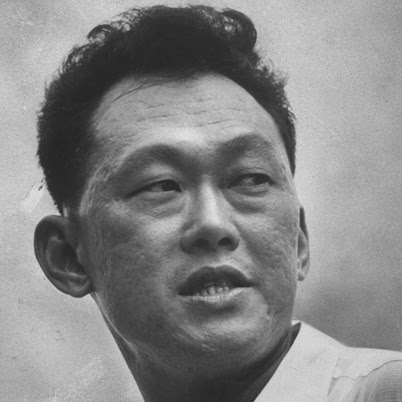
It is interesting to find how much of the Big Society was motivated by a perceived need by Western governments to streamline their "wasteful" welfare states in order to compete with the Asian "tiger" economies (and, in the post-Mao period, China). Lord Patten, the last governor of Hong Kong and a man on the left of the Conservative Party, saw himself as a spokesman for the "Enlightenment values" of liberal democracy and liberal economics, against a tide of hyperbole about supposedly superior "Asian values" that - as interpreted by the erudite Prime Minister of Singapore, Lee Kuan Yew - emphasise obedience to family and state before individual liberty.
Yet in his book East and West even he acknowledged that the West had something to learn from the "Asian values" thesis:
 "The West, it is said, government has become too big as a result of the exaggerated ambitions of politicians and the demands made on them by voters. Citizens in a sense sell their votes to the highest bidders...they are being bribed with their own money. Government finds itself taking decisions, assuming responsibilities, that properly belong to individuals, families, firms. [...] By avoiding the creation of a costly welfare burden for their taxpayers, Asian governments have helped create the growth which ensures that fewer people need welfare support."
And, for Patten, that economic success has an ethical foundation that Western governments could learn from in creating Big Societies:
"Certain basics about human nature [argues Lee Kuan Yew] do not change. Man needs a certain moral sense of right and wrong... Westerners have abandoned an ethical basis of society, believing that all problems are solvable by a good government, which we in the East never believed possible. [...] Those of us who believe in liberal economics have to be careful not to become crude advocates of a mindless materialism and of a concentration on the individualism of human beings as economic agents that obfuscates their civic and social roles... Successful liberal democracies need smaller governments and bigger citizens - bigger citizens playing a larger role in partnership for the common good... We need to seek a new point of balance in our societies, that draws on the experience of smaller governments in some Asian societies."
Here is an interview with Lee Kuan Yew during a trip to the U.S. in 1967. When an American journalist asks him what he makes of the student protests across the country (at 15:30), he replies to the effect that people will always protest against their government, but it is the government's job to ensure that its policies are ones they will later look back on and approve of retrospectively - a sentiment of which I am sure Voltaire would have approved.
At length, I think we have come full-circle. Just as the "enlightened despots" of eighteenth-century Europe were in a sense Christianised versions of theorised benevolent Oriental despots, it is also plausible to see the "radical behaviourism" of B. F. Skinner as a secularised vision of enlightened despotism (in which Darwinian natural selection has taken on the role of divine Providence, and "nudging" technocrats the role of far-sighted philosopher-kings).
Moreover, just as the Jesuits reduced the complexity of China to the principles of Neo-Confucianism in order to justify their assimilationist approach to missionary work, so too have latter-day Western commentators on "Asian values" often simplified a messy reality in order to argue for the necessity of reforming welfare states in the West - and that the way to do it is to harness the power of the state to transform cultural values.
The constant thread running through this story has been the notion that the universe is characterised in a meaningful way by "pre-established harmony", and that, ironically, this can be used to legitimise alternative forms of government to participatory democracy. But if this is true, why don't the enlightened despots ever seem to agree among themselves?